Stakestone connects staking and custodial yield with programmable crypto payments
Stakestone combines ETH staking and other yield products with crypto accounts and programmable payments. STONE represents a share of an ETH yield pool, while STONEUSD and STONEBTC use custodial strategies. Its 2.0 architecture connects these products with social-login accounts, fee abstraction and payment systems for people and automated agents.
In short: Holding STONEUSD in a self-custodied account leaves its underlying assets dependent on custodians and trading strategies.
Deposited assets determine the yield source and custody model
ETH deposits produce STONE through an onchain staking route. Stablecoin and wrapped Bitcoin deposits enter custodial yield products, so the asset determines the strategy and custody dependencies.
ETH deposits mint STONE
The minter issues STONE using the contract’s ETH exchange rate. Deposited ETH first sits in the protocol vault before deployment to approved strategy pools. Those pools derive returns from Ethereum staking and can incorporate restaking exposure. The design includes EigenLayer and Symbiotic integrations, with allocations governed through OPAP. STONE represents ownership of the pooled position, allowing its holder to retain a transferable token while the underlying assets support yield strategies.
Stablecoin and Bitcoin products use external strategies
STONEUSD and STONEBTC connect deposits to custodian-held pools and market-neutral trading strategies. The 2.0 deposit model accepts stablecoins such as USDC and USDT, or wrapped Bitcoin such as BTCB, after customer or business verification (KYC/KYB). Direct STONEUSD minting also requires anti-money laundering (AML) checks and explicit whitelisting. Secondary-market swaps offer permissionless buying and selling of STONEUSD at market prices, subject to available liquidity. The service’s geographic and sanctions restrictions still apply. The described custodial route uses Ceffu accounts and exchange sub-accounts for strategy execution. Returns reflect trading performance and relevant costs. Onchain token records track pool shares and settlement, while trading funds can remain in external custody.
Exchange rates connect token balances to underlying value
A yield token’s exchange rate expresses the underlying asset value represented by each token. STONE uses an ETH-denominated rate and a non-rebasing ERC-20 structure. Accrued staking yield changes the value represented by its units without automatically increasing the wallet’s token count. Portfolio performance also affects the exchange rates for STONEUSD and STONEBTC, through their respective accounting processes.
An unchanged STONE balance with a higher ETH value
In this hypothetical case, a balance stays at 18.76 STONE while the contract exchange rate rises from 1.05 to 1.06 ETH per STONE.
The unchanged balance might seem to show no earned yield. At the earlier rate, 18.76 × 1.05 equals 19.698 ETH. At the later rate, 18.76 × 1.06 equals 19.8856 ETH. The same token holding represents 0.1876 ETH more in gross underlying value.
This calculation applies to the assumed rate increase and unchanged holding. A flat or declining rate changes the outcome. The figures represent contract-rate value before any separate redemption or network costs. An actual redemption also requires available liquidity and settlement.
Personal accounts combine familiar sign-in with programmable controls
Stone Wallet brings personal-account functions into the payment layer. The 2.0 neobank design extends staking infrastructure with self-custodied accounts, automated asset management and programmable fees.
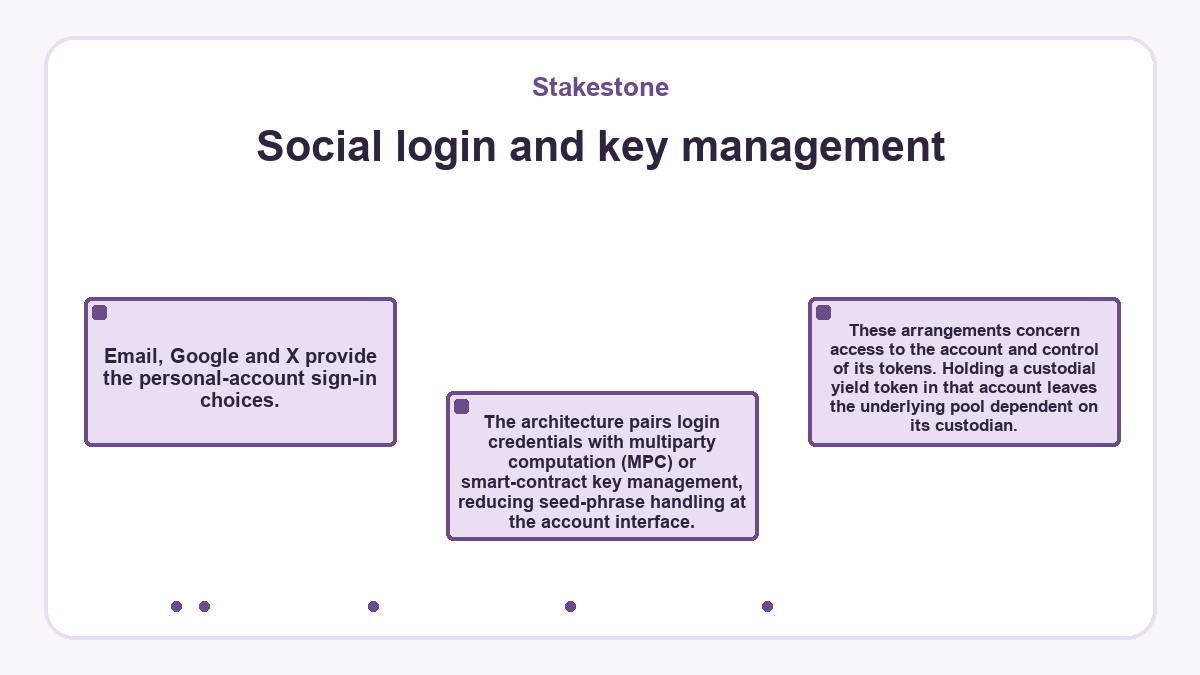
Social login and key management
Email, Google and X provide the personal-account sign-in choices. The architecture pairs login credentials with multiparty computation (MPC) or smart-contract key management, reducing seed-phrase handling at the account interface. These arrangements concern access to the account and control of its tokens. Holding a custodial yield token in that account leaves the underlying pool dependent on its custodian.
Smart-account permissions and gas handling
EIP-7702 enables an externally owned account to use contract-based logic while retaining its address. Within the 2.0 design, this supports spending limits, permission policies and condition-based asset management. Personal-account functions include transfers and QR payments. Relayers or sponsors can handle gas, and fee abstraction can use verified assets to settle network fees. A STONEUSD platform fee, if charged, is included in performance accounting and is not billed separately. Direct redemption fees may apply and must be disclosed before confirmation. Swap providers set their own fees, and STONEUSD’s terms assign network costs to the user.
Agent payments depend on authorization and settlement
The agent-payment layer is designed to combine authorized spending with identity and settlement controls. AP2 and x402 have different roles in the 2.0 architecture.
AP2 carries payment intent
AP2, the Agent Payments Protocol, carries payment authorization through signed mandates. An agent account can create an Intent Mandate under predefined spending conditions. A Cart Mandate incorporates the relevant purchasing context. After verification, the payment intent specifies the amount, recipient and execution conditions. Those details constrain what the account authorizes, including automated actions triggered without a fresh manual instruction for each payment.
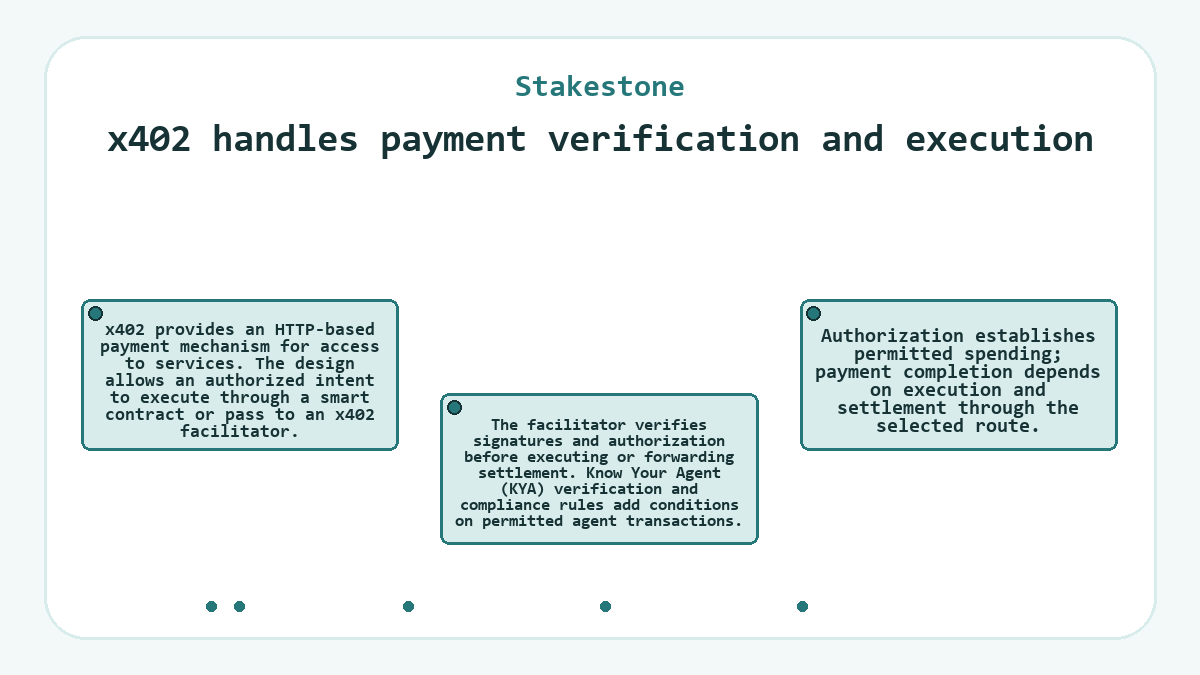
x402 handles payment verification and execution
x402 provides an HTTP-based payment mechanism for access to services. The design allows an authorized intent to execute through a smart contract or pass to an x402 facilitator. The facilitator verifies signatures and authorization before executing or forwarding settlement. Know Your Agent (KYA) verification and compliance rules add conditions on permitted agent transactions. Authorization establishes permitted spending; payment completion depends on execution and settlement through the selected route.
Ethereum accounting and market quotes serve different purposes
The 2.0 settlement model places yield pricing and accounting on Ethereum L1. Distribution can extend to layer-2 networks and appchains through bridged assets and swaps. DEX liquidity or request-for-quotation (RFQ) providers determine the available market price on those routes. A contract exchange rate values a pool share; a market quote describes the terms of a particular trade. Liquidity depth, trade size and provider fees can affect a swap. STONE’s LayerZero-based Omnichain Fungible Token (OFT) design supports cross-chain transfers. Each transfer requires supported deployments at both ends.
OPAP and STO govern different parts of the system
OPAP, the Optimizing Portfolio and Allocation Proposal mechanism, governs STONE’s underlying strategies and the allocation of ETH among them. STONE holders vote on proposed changes, with timelocks preceding execution. An approved allocation determines the pool’s exposure to particular yield strategies. Changing that allocation can alter the sources of returns and the protocols on which the pool depends. Individual holders retain their STONE shares while the pooled strategy changes.
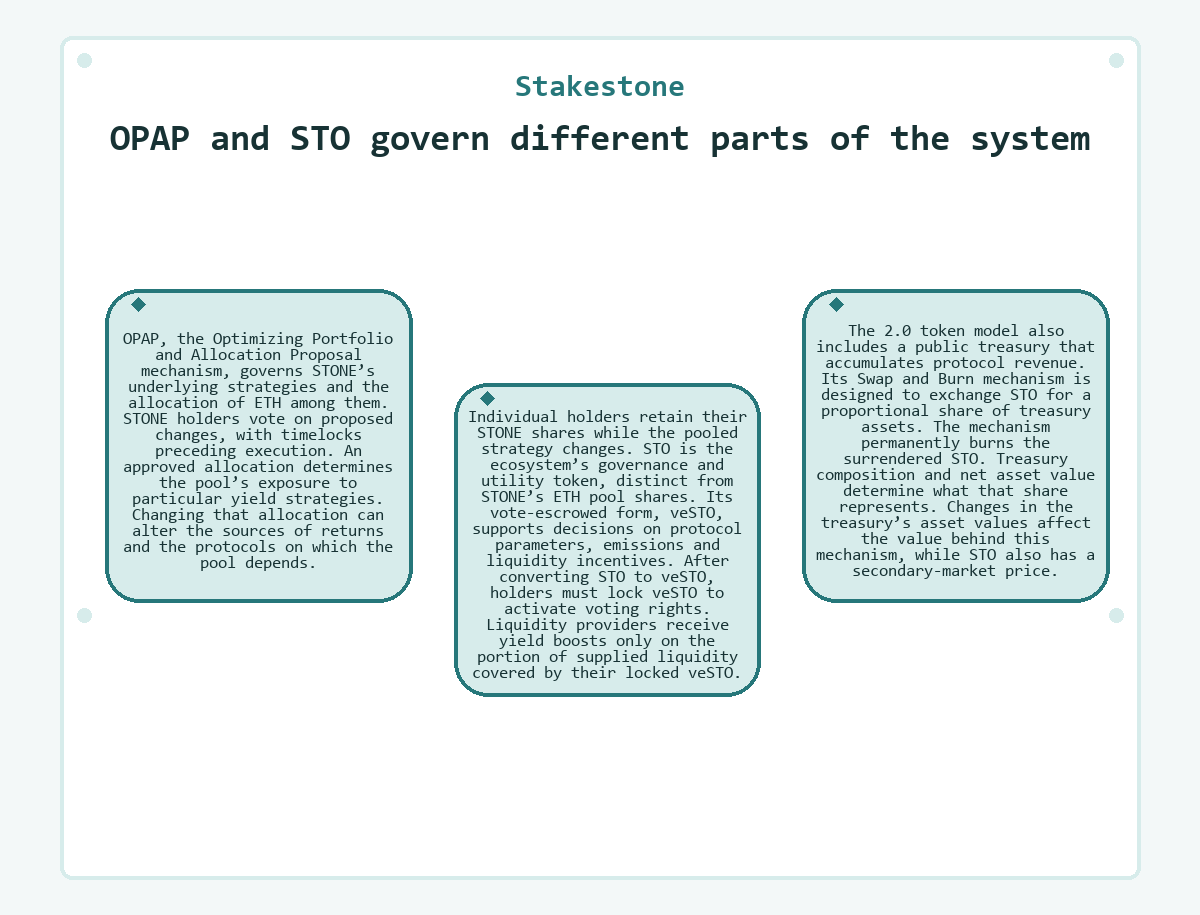
STO is the ecosystem’s governance and utility token, distinct from STONE’s ETH pool shares. Its vote-escrowed form, veSTO, supports decisions on protocol parameters, emissions and liquidity incentives. After converting STO to veSTO, holders must lock veSTO to activate voting rights. Liquidity providers receive yield boosts only on the portion of supplied liquidity covered by their locked veSTO.
The 2.0 token model also includes a public treasury that accumulates protocol revenue. Its Swap and Burn mechanism is designed to exchange STO for a proportional share of treasury assets. The mechanism permanently burns the surrendered STO. Treasury composition and net asset value determine what that share represents. Changes in the treasury’s asset values affect the value behind this mechanism, while STO also has a secondary-market price.
What determines how quickly yield tokens can be redeemed?
Redemption timing follows the asset’s liquidity and settlement process, with distinct conditions for STONE and custodial yield tokens. The buffer-based Instant Withdrawal route for STONE requires sufficient ETH in the buffer pool. A Request Withdrawal becomes claimable after the protocol completes unstaking, secures redeemable liquidity and finalizes the settlement cycle. The exchange rate determines the corresponding ETH value.
STONEUSD and STONEBTC settlement depends on recalling funds from custody and closing relevant strategy positions before releasing underlying assets. STONEUSD direct redemption also remains subject to eligibility, processing time and asset availability. Market stress, operational incidents or regulatory considerations can lead to delayed or suspended STONEUSD redemptions. A secondary-market sale uses available trading liquidity and a market price, with a different set of conditions from direct redemption.
Identity credentials and backing assets require different safeguards
The 2.0 compliance design uses zero-knowledge credentials for onchain identity verification. Account status can be compliant, restricted or pending, affecting transaction permissions. STONEUSD access also carries geographic and sanctions restrictions. These access rules govern who can use particular services, independently of the yield strategy. The privacy design limits the personal information revealed during onchain verification; it does not change where a custodial product holds its backing assets.
Custodian attestations address backing assets, while contract audits examine code. The STONEUSD portfolio still depends on custodians, exchanges and trading counterparties. Poor portfolio performance can reduce its exchange rate and the value of a holder’s claim. STONE’s ETH route instead retains exposure to the protocols that stake and restake its backing. Onchain records make token issuance and settlement traceable, while external custody and strategy execution introduce their own operational dependencies.
Quick answers about Stakestone
Can STONE itself be deposited directly into a restaking protocol?
In STONE’s yield model, restaking applies to the underlying strategy assets. STONE represents a share of the pool. Whether a separate protocol accepts STONE directly is an integration question; the pool’s exposure to restaking does not establish that compatibility.
Does signing in with Google satisfy STONEUSD’s identity requirements?
Google login provides account access, while direct STONEUSD minting and redemption require approved KYC/KYB, AML checks and whitelisting. Sign-in credentials and permission to enter the protocol are separate requirements. Access to those direct services can be denied or suspended based on verification results.
What does a STONEUSD redemption request ID confirm?
A request ID identifies a redemption order after its initial checks in the 2.0 custodial withdrawal process. Assets must still return from custody and undergo settlement. Completion involves burning the corresponding yield tokens and releasing underlying assets to the wallet, so the identifier alone does not confirm payment.
Is STONEUSD’s exchange rate updated on a weekly schedule?
The 2.0 settlement model specifies a weekly snapshot at 00:00 UTC on Thursday for STONEUSD and STONEBTC. It aggregates deposit, withdrawal and yield records to update the R value and publish the accounting state. That schedule does not guarantee that every withdrawal finishes at the same time.
How does veSTO affect fee rebates?
The 2.0 model ties platform fee-rebate eligibility to a veSTO holder’s tier. The rebate categories include transfer and on-ramp or off-ramp fees. Eligibility for a rebate on those charges does not establish a discount on every network fee or third-party swap cost.
Can I send a payment by email with Stakestone?
Personal-account functions include email-based transfers alongside QR payments. Using an email address to sign in is a separate account-access function.
Why does zero-knowledge verification still involve an identity provider?
The 2.0 compliance design uses an identity provider to verify personal data before issuing the credential for onchain proofs. The onchain proof demonstrates the relevant compliance status without publishing plaintext personal information to the contract. The provider still receives the information needed to perform its customer checks.