Stakestone OPAP puts STONE strategy and allocation changes to a holder vote
Stakestone OPAP governs changes to STONE’s underlying strategies and ETH allocations through proposals and onchain votes. STONE holders vote for or against each proposal, with voting weight determined by locked STONE. A change requires more affirmative than opposing weight at the end of the public notice period.
Jump to a section
The short version: An OPAP proposal with no affirmative or opposing votes when voting ends will not change STONE’s underlying portfolio.
OPAP connects holder decisions with the STONE strategy pool
The Optimizing Portfolio and Allocation Proposal mechanism governs the strategies that back STONE and their ETH allocations. STONE represents a share of an ETH yield pool. The vault holds deposited ETH before deployment, while strategy pools put that capital into staking and restaking positions. OPAP supplies the governance decisions that determine the underlying portfolio. In the 2.0 design, strategy pools generate yield and the main contract performs settlement using their consolidated yield data.
The minter issues STONE when ETH enters the system, and the vault receives the deposited assets. Governance concerns the assets and allocations behind those tokens. All STONE holders share the portfolio choices made for that pooled backing.
Portfolio additions expand the underlying strategy set
OPAP portfolio optimization can add new strategies to STONE’s underlying assets. A proposal to add a route concerns the set of strategies that may receive capital. It needs a holder decision before implementation. The route’s potential yield belongs alongside its liquidity and technical dependencies when assessing the proposed addition.
A new route can introduce exposure to another protocol or a different yield mechanism. Evaluating the portfolio addition therefore includes the relevant smart contracts, counterparties and available liquidity. Approval of the route establishes its governance acceptance; its actual contribution depends on the capital allocated to it and the performance of the underlying strategy.
Allocation changes redistribute ETH among strategies
Allocation optimization changes the proportion of ETH assigned to the strategies within STONE’s underlying portfolio. The approved strategy set can remain unchanged while its relative weights change. Existing routes then account for different portions of the pooled exposure, without requiring the proposal to introduce another protocol.
An allocation percentage describes a share of the underlying ETH, not an annual yield or voting threshold. Moving a larger share toward a route increases the pool’s exposure to that route’s performance and dependencies. The governance decision therefore concerns both where ETH goes and how strongly each strategy contributes to the whole.
Portfolio additions and allocation adjustments can appear in the same proposal. Its full effect includes both the newly admitted route and the revised distribution of capital.
Proposal publication precedes a decision on execution
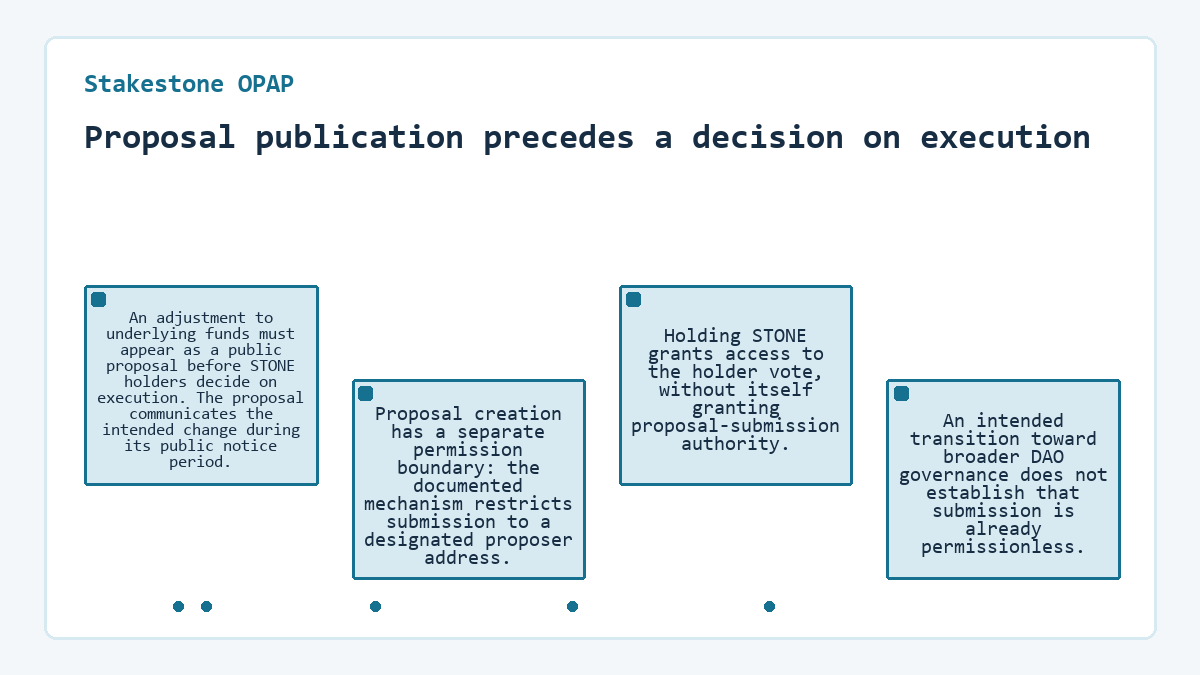
An adjustment to underlying funds must appear as a public proposal before STONE holders decide on execution. The proposal communicates the intended change during its public notice period. Proposal creation has a separate permission boundary: the documented mechanism restricts submission to a designated proposer address. Holding STONE grants access to the holder vote, without itself granting proposal-submission authority. An intended transition toward broader DAO governance does not establish that submission is already permissionless.
How does locked STONE determine voting weight?
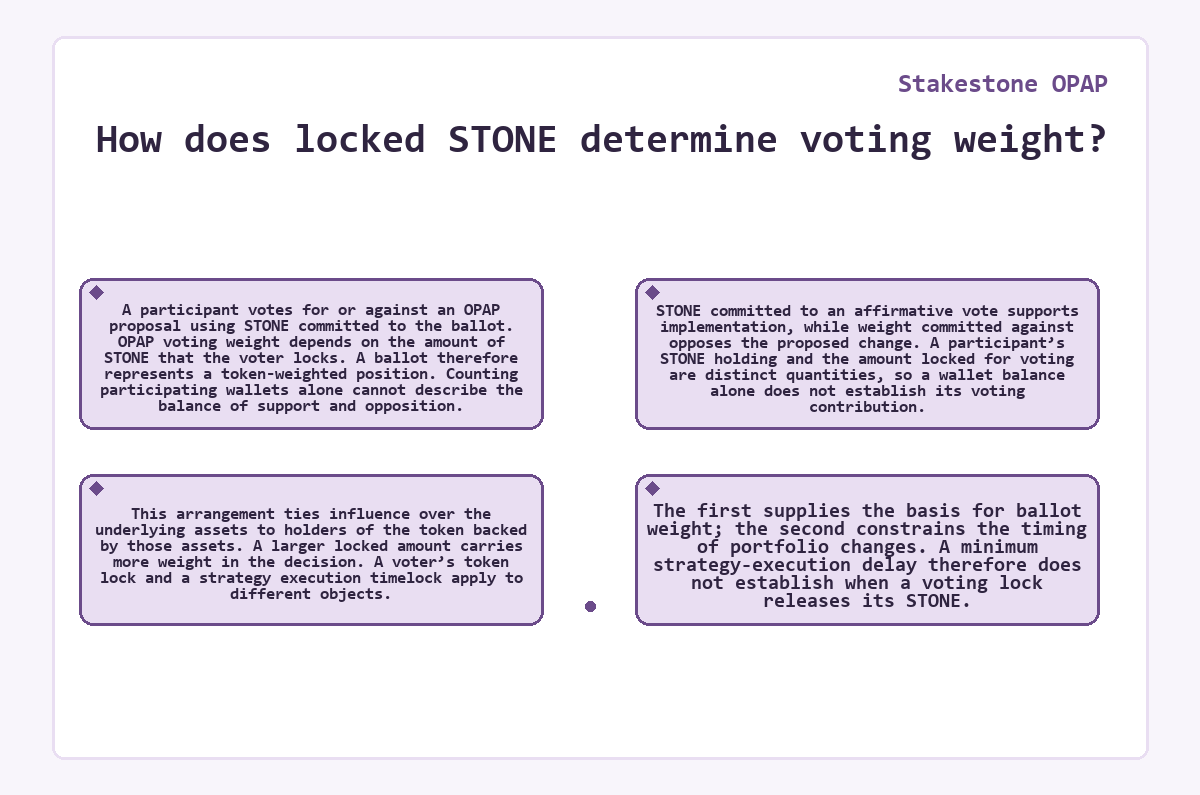
A participant votes for or against an OPAP proposal using STONE committed to the ballot. OPAP voting weight depends on the amount of STONE that the voter locks. A ballot therefore represents a token-weighted position. Counting participating wallets alone cannot describe the balance of support and opposition.
STONE committed to an affirmative vote supports implementation, while weight committed against opposes the proposed change. A participant’s STONE holding and the amount locked for voting are distinct quantities, so a wallet balance alone does not establish its voting contribution.
This arrangement ties influence over the underlying assets to holders of the token backed by those assets. A larger locked amount carries more weight in the decision.
A voter’s token lock and a strategy execution timelock apply to different objects. The first supplies the basis for ballot weight; the second constrains the timing of portfolio changes. A minimum strategy-execution delay therefore does not establish when a voting lock releases its STONE.
Support must exceed opposition when the notice period ends
A proposal passes the documented voting condition when affirmative weight exceeds opposing weight at the notice period’s end. An early lead in the tally does not establish the final decision while voting remains open. Publication, voting and the final decision describe different states of the proposed change.
A proposal receiving neither affirmative nor opposing votes when voting ends will not be implemented. The proposal still exists as a published intention, but it has not gained the holder decision needed to change the portfolio.
Approval defines the permitted change; execution applies it to the underlying assets. The STONE mechanism describes multisignature strategy operations controlled by partners such as Cobo and Coincover. Holder voting and operational signing therefore contribute different parts of the portfolio change.
The contract timelock constrains strategy execution
The documented OPAP mechanism specifies a minimum smart-contract timelock of 24 hours. Longer delays can apply to strategy changes. That minimum therefore cannot serve as a universal forecast of when a particular proposal will execute.
The delay provides time for scrutiny and community feedback before a change takes effect. Holder approval and satisfaction of the execution timing constraint remain different conditions. The minimum delay also does not establish a complete elapsed time from publication to implementation. A proposal’s actual notice period and applicable execution timing govern that transition. Likewise, the timelock cannot supply a promised withdrawal date for ETH already deployed into a strategy.
An allocation proposal can pass without adding a strategy
A successful allocation vote can change the balance between existing strategies without expanding the approved portfolio. In this hypothetical example, a proposal reweights ETH between two already approved routes and introduces no new route. At the end of its public notice period, votes backed by 1842 locked STONE support it and votes backed by 967 locked STONE oppose it.
Affirmative backing exceeds opposing backing by 875 STONE. The proposal therefore satisfies the documented affirmative-vote condition. The amounts describe token-weighted voting positions, not ETH allocations or the pool’s total STONE supply.
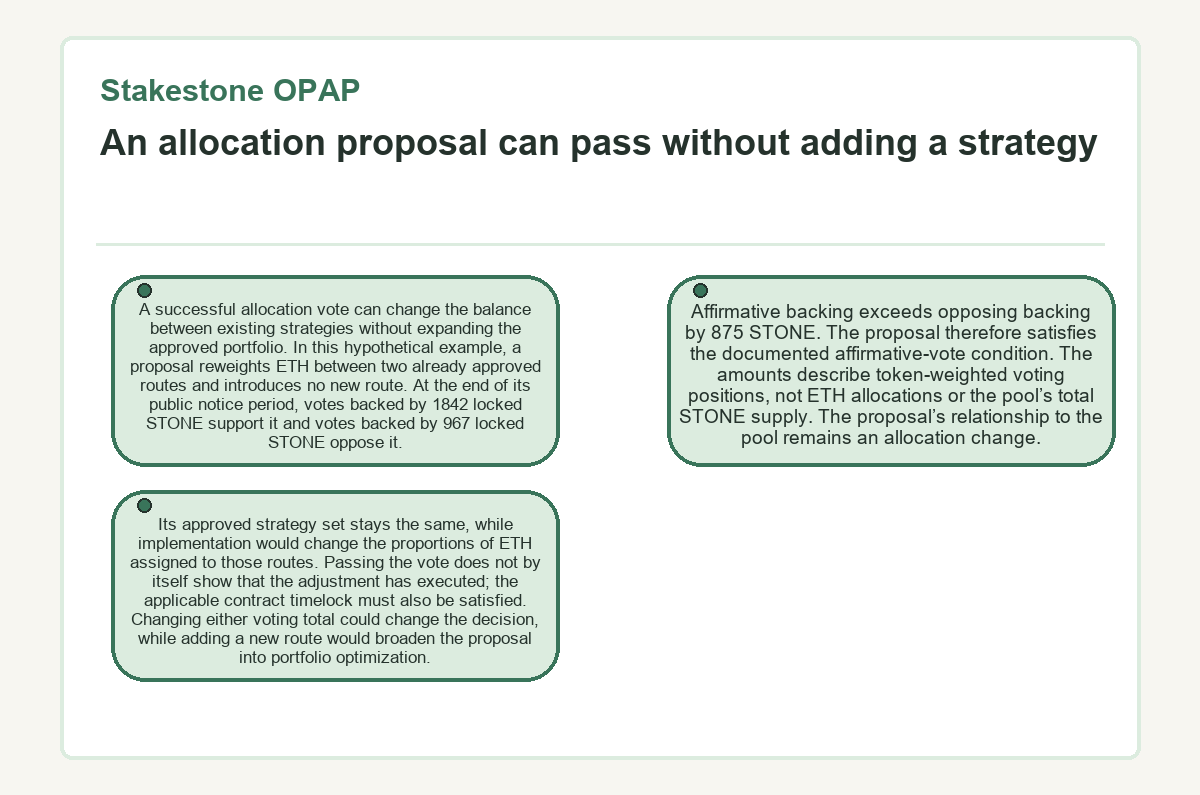
The proposal’s relationship to the pool remains an allocation change. Its approved strategy set stays the same, while implementation would change the proportions of ETH assigned to those routes. Passing the vote does not by itself show that the adjustment has executed; the applicable contract timelock must also be satisfied. Changing either voting total could change the decision, while adding a new route would broaden the proposal into portfolio optimization.
Liquidity and technical dependencies qualify the proposed yield
OPAP’s asset evaluation gives safety priority over advertised yield when assessing potential additions to STONE’s portfolio. Its risk categories cover market, counterparty and technology risks. Each category describes a different dependency, so a strong yield quotation cannot answer every concern about a proposed strategy.
Market-risk assessment considers liquidity. Assets may contribute to pooled backing while offering limited liquidity when a strategy needs to rebalance. Available liquidity also affects slippage and the price impact of moving capital. The size of an allocation therefore matters alongside the route itself: assigning more ETH to a strategy increases the amount exposed to its liquidity conditions.
Counterparty-risk assessment includes governance, legal issues and centralization. A strategy that interacts with another protocol inherits relevant dependencies on that protocol’s controls. Technology-risk assessment covers smart contracts and oracle reliability. A portfolio vote authorizes exposure to those systems; it does not remove their operational requirements or establish that every underlying component will perform without failure.
The evaluation process considers third-party audits, adoption measured through staked onchain wallets and liquidity. Audits address examined code and findings, while adoption describes usage. Neither measure alone establishes sufficient liquidity for a proposed allocation.
Earlier approvals identify routes without fixing current allocations
Past OPAP approvals include Symbiotic, EigenLayer, Rocket Pool, Curve, Balancer and Mellow. These names identify protocols that have appeared in the portfolio-governance history. They do not establish that every named route currently holds ETH, or that historical approval preserves an unchanged allocation. The mechanism explicitly permits later portfolio and allocation changes.
Historical acceptance, assigned capital and realized yield describe different properties of a strategy. Similarly, a restaking protocol’s approval identifies an underlying strategy dependency; it does not turn the STONE token itself into the asset deposited directly for restaking. The relevant exposure comes through the assets backing STONE, including routes associated with EigenLayer.
Details worth knowing about Stakestone OPAP
-
What happens if an OPAP vote ends in a tie?
- A tied result does not meet OPAP’s requirement for more affirmative than opposing voting weight. The comparison applies at the end of the public notice period. Equal totals therefore do not establish approval, even if participants voted on both sides of the proposal.
-
Can locked veSTO substitute for STONE in an OPAP ballot?
- The documented OPAP ballot uses locked STONE as its voting-weight basis. veSTO belongs to separate governance functions, including liquidity-incentive allocation and protocol parameters. Its voting rights should not be treated as a substitute for the STONE commitment used to decide changes to STONE’s underlying strategies.
-
Who reviews a new strategy’s risks before an OPAP vote?
- OPAP asset evaluation includes risk assessments from a committee of the largest institutional STONE holders. Their reviews contribute internal due diligence about a proposed asset’s suitability. They complement the consideration of audits, adoption and liquidity; holder voting still determines the proposal’s decision.
-
Does an OPAP approval require holders to exchange STONE for a replacement token?
- An OPAP portfolio adjustment does not require a replacement token merely because the underlying strategy changes. The minter separates STONE issuance from management of its backing assets, allowing adjustments without changing the circulation of issued STONE. The governance decision concerns the pool behind the existing token.
-
Is an OPAP majority measured against all circulating STONE?
- OPAP’s stated majority test compares affirmative and opposing weighted votes cast on the proposal. Those weights derive from the STONE locked for the respective ballots. Uncommitted holdings do not themselves contribute affirmative voting weight, so a token’s presence in the circulating supply does not establish support for a proposal.
-
Do OPAP votes authorize an agent to spend from a personal account?
- An OPAP decision governs STONE’s underlying strategies and allocations. An agent’s spending authority comes from its account permissions and payment authorization. Approval of a pooled strategy change does not supply permission to make a personal payment or set the recipient of that payment.